Understanding the Employee Lifecycle Management Process
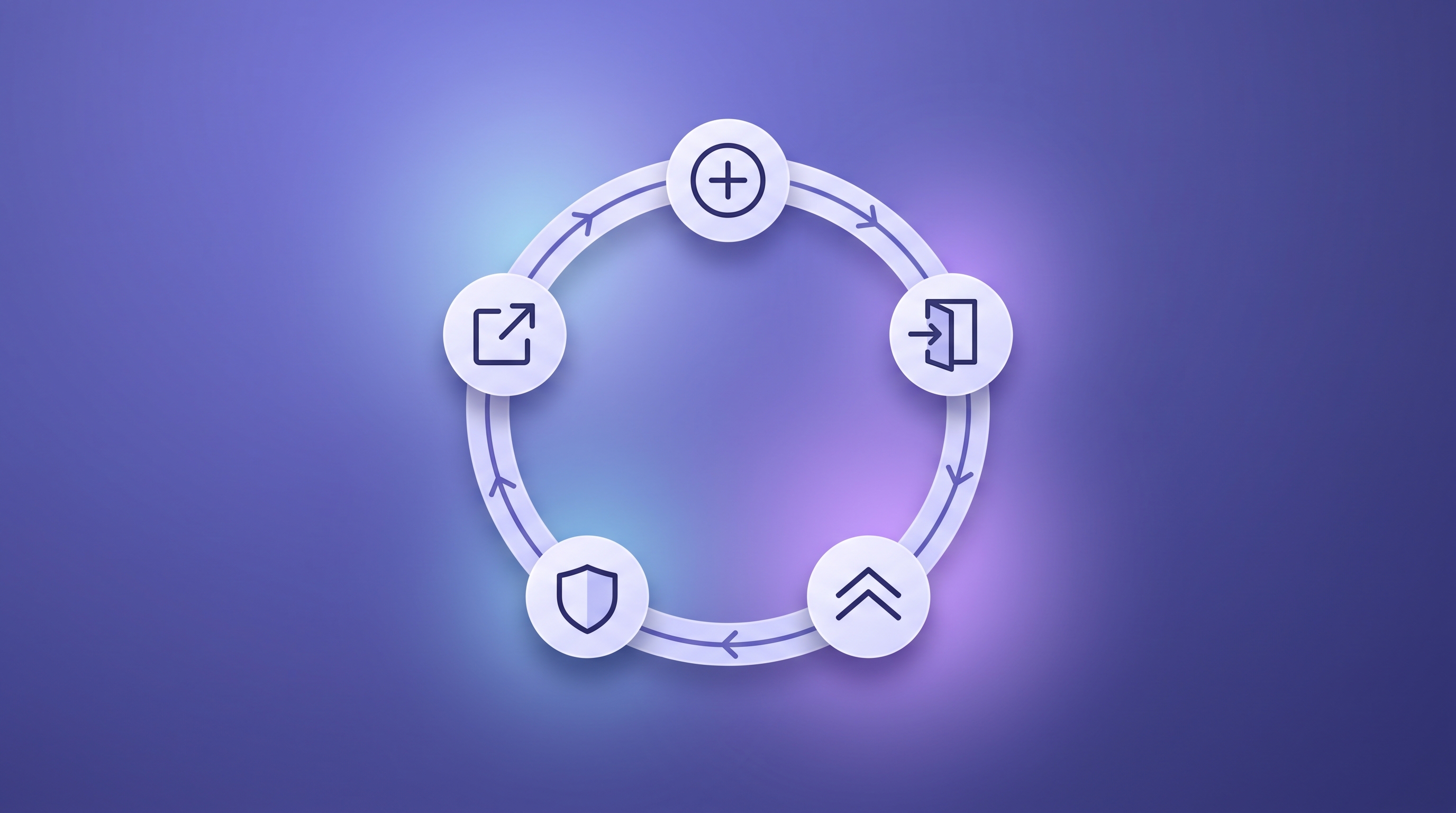
Employee lifecycle management is the practice of guiding a person through every stage of their time with your company, from their first application to their last day. Done well, it helps people ramp up faster, stay longer, and do better work along the way.
This guide walks through each stage of that lifecycle, why it matters, and what it looks like when the stages are connected instead of scattered across five different tools.
What Is Employee Lifecycle Management?
Employee lifecycle management is a way of organizing everything a company does for its people into a clear sequence of stages. Instead of treating hiring, HR, and career growth as separate problems, it treats them as one continuous relationship.
The stages usually look like this:
- Recruitment and hiring — attracting and selecting the right people
- Onboarding — getting new hires ready to do real work
- Development and performance — building skills and giving feedback
- Engagement and retention — keeping people motivated and committed
- Career growth — helping people move up or across the organization
- Offboarding — handling departures with care
Each stage feeds the next. A messy hiring process makes onboarding harder. A weak onboarding experience hurts retention. Managing the lifecycle well means paying attention to the handoffs, not just each stage on its own.
Why Employee Lifecycle Management Matters
A disconnected lifecycle costs more than most companies realize. When hiring data lives in one tool and HR records live in another, someone has to manually carry details from one system to the next — and details get lost or mistyped along the way.
Onboarding is a good example of how much is riding on this. Research summarized by StrongDM shows that organizations with a structured onboarding process retain 82% of new hires, compared to 62% at companies without one. The same research found that new hires reach full productivity roughly 50% faster when a company has a standard onboarding process in place. That's a large gap for what is, in practice, a checklist problem.
Stage 1: Recruitment and Hiring
Good hiring starts with a clear, honest job posting: the role, the requirements, the salary band, and what a good candidate actually looks like. Vague postings attract vague applicants, and that shows up later as mismatched hires.
From there, the goal is a single pipeline everyone on the hiring team can see — one place to track applicants, interview notes, and ratings, instead of a scatter of emails and spreadsheets. In CrewFoundry, job postings and the candidate pipeline live on one data model, so a candidate's contact details, source, and interview feedback stay attached to them instead of getting re-typed between an applicant tracker and an HR system. You can see how that works on the job postings and hiring funnel page.
Cultural fit matters here too, but it should never be code for "someone we already know." The safest way to hire for fit is to define it in terms of how someone works, not who they remind you of.
Stage 2: Onboarding
Onboarding is where the promise made during hiring either holds up or falls apart. New hires form lasting impressions in their first few weeks, and a slow or disorganized start is hard to recover from.
A structured onboarding plan breaks the process into clear stages with an owner and a due date on every task, so nothing depends on someone remembering to follow up. CrewFoundry's onboarding tracker, for example, walks every new hire through five stages — Offer, Paperwork, IT Setup, Training, and Day 1 — with a task, an owner, and a due date at each step, plus a live progress percentage so HR can see exactly where each hire stands. You can see the full picture on the onboarding checklist page.
The point isn't to automate away the human parts of onboarding, like a manager's welcome or a first team lunch. It's to make sure the logistics — paperwork, equipment, system access, training — never get in the way of them.
Stage 3: Development and Performance
Once someone is settled in, the next job is helping them grow. That starts with clear expectations: what does good performance look like in this role, and how will it be measured?
Regular, specific feedback matters more than an annual review. A manager who flags an issue in the moment gives someone a real chance to adjust course; a manager who saves it for a review cycle six months later does not.
Tools are starting to catch up with this shift. A running performance signal — built from real inputs like hiring ratings and ongoing feedback, rather than a single form filled out once a year — gives managers and HR a current read instead of a stale snapshot. CrewFoundry keeps a signal like this on every employee record today, with fuller review workflows on its roadmap as the product builds toward launch.
Stage 4: Engagement and Retention
Engagement is built in small, repeated moments: being told about a change before it happens, having a way to ask questions, and being recognized when work goes well.
A few things reliably move the needle:
- Clear communication. People disengage when they feel out of the loop. Company-wide updates should be easy to find and easy to tell apart from routine chatter — CrewFoundry, for instance, keeps announcements separate from day-to-day conversations so a policy change doesn't get buried under lunch plans.
- Fair, transparent compensation. People compare notes. Pay that feels arbitrary erodes trust faster than almost anything else.
- A supportive environment. Manageable workloads and psychological safety matter more to retention than most perks do.
Retention is easier to protect than to win back. Once someone starts job-searching, most companies never fully recover their trust — even with a counteroffer.
Stage 5: Career Development and Internal Mobility
People stay longer when they can see a future at your company. That future doesn't have to mean a promotion every year — lateral moves, stretch projects, and new skills all count.
Mentorship is one of the simplest tools here. Pairing someone with a person a few steps ahead of them gives them a model for where they could go and someone to ask questions along the way.
This is also where a shared skills record starts to pay off. When the same skill tags follow a person from their original job application through their time as an employee, it becomes possible to match them to new projects or internal openings based on what they can actually do — not just their current job title. This is the direction CrewFoundry is building toward: skills already attach to employee and candidate records today, and connecting that data to internal moves and learning paths is on the roadmap.
Stage 6: Separation and Offboarding
Every employee eventually leaves, and how that's handled says a lot about a company. A good offboarding process protects the departing employee's dignity, the team's continuity, and the company's reputation, all at once.
A solid offboarding checklist typically covers:
- An honest exit conversation. Not every exit interview will be useful, but a well-run one can surface real problems before they cause more departures.
- Knowledge transfer. Document what the departing person knows before they're gone, not after.
- Access and equipment. Revoke system access and collect equipment promptly, as a routine step rather than an afterthought.
- A respectful goodbye. Former employees talk. Treating a departure well is part of your hiring reputation, not separate from it.
Bringing the Lifecycle Together in One Place
Most of the friction in employee lifecycle management doesn't come from any single stage — it comes from the seams between them. A candidate's information gets re-typed into an HR system. Time and leave records live apart from payroll. Performance notes sit in yet another tool.
CrewFoundry's approach is to keep that whole journey as one connected record instead of five disconnected ones: a person's path from candidate, to employee, to onboarding, to project work, to time and leave, to payroll status, all sit in the same workspace. You can see the shape of that in how CrewFoundry maintains the employee directory and org model.
CrewFoundry is a pre-launch platform, currently building toward its 2026 launch. If this kind of connected lifecycle is something your team needs, you can explore the full feature set or join the waitlist to get early access as it rolls out.
Common Mistakes and Best Practices
A few patterns show up again and again in companies that struggle with lifecycle management:
- Treating each stage as its own project. Hiring, HR, and learning teams that don't talk to each other end up solving the same problems in different tools.
- Under-investing in onboarding. It's the highest-leverage stage for retention, and often the most neglected.
- Skipping the paper trail. Without a record of who owns what, tasks quietly fall through the cracks.
- Ignoring offboarding until it's urgent. A rushed exit process creates security gaps and bad final impressions.
The best practice underneath all of these is the same: keep the data connected, keep ownership clear, and revisit the process as your company changes. Lifecycle management isn't a project you finish — it's a system you maintain.
Frequently Asked Questions
What are the stages of the employee lifecycle?
The employee lifecycle typically includes recruitment, onboarding, development, engagement, retention, career growth, and offboarding. These stages describe how a company supports and manages someone from their first application through their last day.
Why is employee lifecycle management important?
It helps companies keep new hires productive faster, retain people longer, and avoid the data loss and rework that come from managing each stage in a separate tool. Structured onboarding alone has been linked to significantly higher new-hire retention.
How does CrewFoundry support employee lifecycle management?
CrewFoundry keeps candidate, employee, onboarding, time and leave, and payroll records connected in one workspace, and includes a five-stage onboarding checklist with owners and due dates. CrewFoundry is currently pre-launch — you can join the waitlist for early access.
What tools are essential for employee lifecycle management?
At minimum, you need a way to track hiring, a system of record for employee data, a structured onboarding process, and a way to track time, leave, and performance. The fewer separate tools that data has to move between, the less gets lost.
How can companies improve employee retention?
Start with a structured onboarding process, since that's where the biggest, fastest gains usually show up. Beyond that, clear communication, fair compensation, and real opportunities for growth are the factors that consistently keep people around.
Ready to see what a connected employee lifecycle looks like in practice? Join the CrewFoundry waitlist or explore the features built to support it.